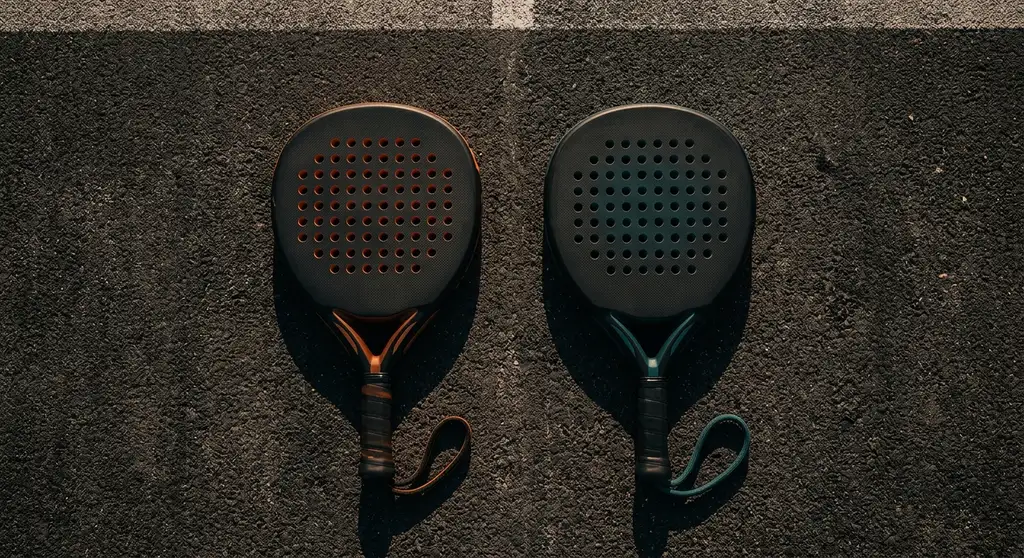
Search “padel set” on Amazon and you’ll get two completely different products mixed into one results page. Some are proper court-padel rackets bundled with balls. Others are solid wooden beach bats sold for garden and seaside knockabouts, wearing the same label because the search term is ambiguous and retailers know it drives traffic either way.
That mix-up matters. Turn up to a booked court with a beach-bat set and you can’t play – the racket doesn’t meet the sport’s basic construction rules, and neither do the balls. This guide sorts out what a “padel set” listing usually contains, when buying one is the right call, and what to buy instead if you’re playing on a real court.
What’s in a padel set: the beach-bat trap
A padel set typically bundles two rackets and a few balls. Some are real court-padel gear; others are beach bats sold under the same search term.
A real padel racket has a solid, foam-cored face covered in small drilled holes, no strings, and a short handle with a wrist strap. A beach bat – sometimes called a paddle-ball bat, matkot, or frescobol paddle – is a flat, rigid piece of wood or composite with no holes and no internal foam layer. They look similar in a thumbnail photo. They play nothing alike.
The holes aren’t decorative. They reduce air resistance and let the racket generate spin, which is central to how padel is played – the bajada, the defensive lob, the way the ball comes off the back glass. A solid beach bat can’t reproduce any of that, and it isn’t legal for competitive or club play because it doesn’t meet the sport’s equipment rules.
Before buying anything labelled “padel set,” zoom into the product photos and check for the drilled holes. If the listing shows a smooth, solid face, or the description mentions “beach,” “matkot,” or “paddle ball,” it’s not court-padel equipment – no matter how the title reads. A proper padel set will usually show the perforated face clearly in its photos, because it’s the detail that signals authenticity to anyone who already knows the sport.
Are bundled padel sets worth it?
Rarely, for a serious player. Bundled sets typically compromise on racket weight, grip fit, and ball quality to hit a low combined price point.
Even once you’ve filtered out the beach bats, most bundled padel sets are still a compromise. Two rackets sold as a matched pair are usually identical in weight and grip size, with no consideration for who’s holding which one – fine if two similarly built adults are sharing, less fine if one player is smaller or has different hand size needs. A single unisex spec has to serve two different people, which means it serves neither particularly well.
Foam quality is the other corner that gets cut. A racket’s core determines power, comfort, and how kind it is on your elbow – and it’s also the most expensive part to get right. Budget sets bundling two rackets and balls for £30-40 are working with a foam cost that a single £70 racket wouldn’t accept. The foam in cheap bundles tends to compress and lose its response within weeks of regular play, which is a fast way to develop a dead-feeling racket and, for some players, real arm discomfort.
Balls are the quieter problem. Court-padel balls need to meet a specific pressure and bounce spec – the International Padel Federation’s rules set internal pressure between 4.6 and 5.2 kg per 2.54 square cm and a bounce of 135-145cm from a 2.54m drop. Balls bundled into cheap sets often don’t state compliance with this spec at all, and on a proper indoor court they can feel dead or unpredictably lively compared with a tube of dedicated padel balls.
None of this means every bundled set is bad. It means the combined price point of a “set” rarely leaves room for two decent rackets and compliant balls at once. Something gives, and it’s usually quality you’d notice within a month of regular play.
When a set makes sense
A bundled set suits garden play, a gift for someone not yet committed to court padel, or a low-stakes way to try the sport before investing properly.
There are real cases where a bundled set is the sensible buy, not a compromise.
Garden or holiday play. If you want something to knock about on grass, sand, or a driveway with family, you don’t need court-legal equipment. A cheap set built for casual, low-intensity hitting does exactly what it’s meant to – just don’t expect it to translate to an indoor court booking.
A gift for someone who hasn’t committed yet. If you’re buying for someone who’s mentioned padel once and hasn’t been on a court, a set is a reasonable way to test interest without spending £70-150 on a proper racket they might not use again. Our padel gifts guide covers this in more depth, including options beyond a bundled set.
Trying the sport for the first time, cheaply. If you’re not yet sure padel is for you and want to hit a few balls before booking a proper session, a low-cost set removes the barrier to just trying it. Just be clear-eyed that it’s a taster, not the equipment you’ll play with once you’re hooked.
In each of these cases, the compromises that make a set a poor fit for serious play – mismatched specs, softer foam, uncertain ball quality – matter much less than the low cost and zero-commitment nature of the purchase.
What to buy instead for real court padel
Buy a single racket suited to your level, plus a tube of proper padel balls. It costs roughly the same as a set and performs far better.
If you’re booking courts regularly, or plan to, the better buy is almost always a single racket chosen for your level and grip, paired with a tube of two or three balls that meet the sport’s spec. A £60-80 racket with proper foam and construction, plus a £5-8 tube of balls, lands close to what a “matching pair” set costs on the receipt – but the quality difference is substantial.
Buying one racket also means you can choose the right shape, weight, and grip for your own hand rather than accepting a generic spec built to fit two people at once. Our first padel racket guide walks through exactly how to choose: shape, weight window, core material, and what to spend. If you’re buying for a child rather than yourself, the sizing considerations are different again – see our kids padel racket guide.
This is the honest version of the advice retailers selling sets won’t give you: a bundle looks like better value on the price tag, but a single decent racket and real balls will serve you better on every court booking you make.
Frequently asked questions
Is a padel set the same as padel rackets?
Not always. Some listings under “padel set” are proper court-padel rackets bundled with balls. Others are beach-bat sets – solid wooden paddles with no drilled holes, built for a different game entirely. Check the product photos for the perforated face before buying.
What’s included in a padel starter set?
Usually two rackets, a tube of two or three balls, and sometimes a bag or carry case. Quality varies hugely between listings at the same price point, and cheaper sets tend to compromise on foam quality and ball spec compliance.
Should I buy a padel set or just one racket?
If you’re playing on a real court regularly, buy one decent racket suited to your grip and level, plus a tube of proper balls. Save the bundled set for garden play, a gift for someone not yet committed to the sport, or a cheap way to try padel before investing properly.