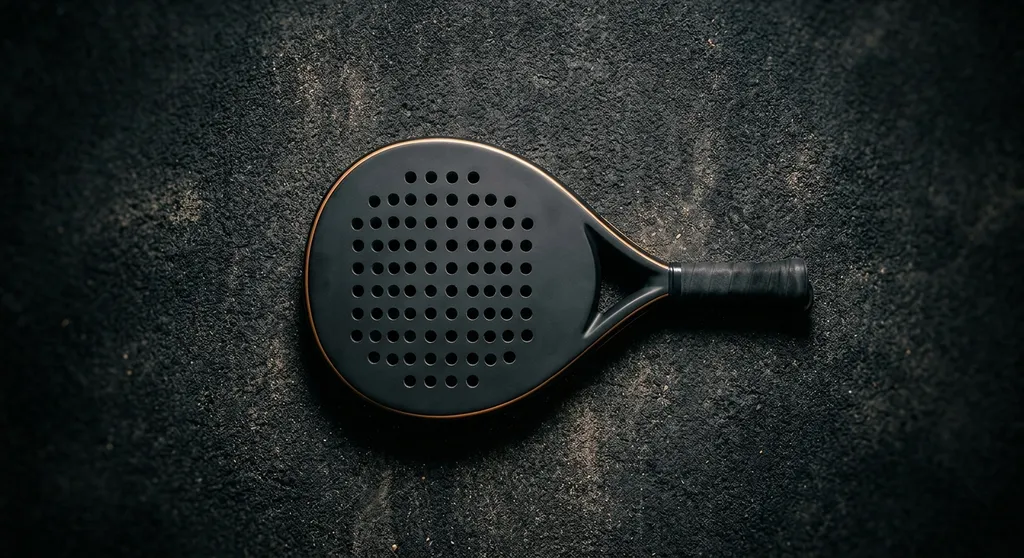
If your elbow aches on the outside after a session, or you’re trying to avoid finding out what that feels like, the racket in your hand matters. Technique, grip size, and warm-up habits all play a part too, but a hard, head-heavy racket asks your forearm to absorb more shock on every single shot, hundreds of times a session.
This guide covers the racket specs that reduce elbow strain, and names specific UK-available rackets worth considering at a few price points. A racket change reduces risk – it doesn’t cure tennis elbow on its own.
Why some rackets strain your elbow more
Four specs drive how much shock reaches your forearm on contact: core density, overall weight, head shape, and balance point.
Core. Padel rackets have no strings – the face is a perforated sheet of carbon or fibreglass over a foam core, so vibration transfers directly into your hand and wrist instead of dispersing through a string bed. A soft EVA foam core absorbs more of that shock before it reaches you. Harder, denser cores (often marketed for power or spin) transmit more of it straight up the arm.
Weight. Every gram above what your forearm can comfortably decelerate adds load to the tendons that attach at your elbow. Our racket weight guide covers this in detail. There is no proven cut-off, but if your elbow is already sore, staying at the lighter end of the usual range gives your forearm less to control.
Shape. Round shapes centre the sweet spot in the middle of the face, so an off-centre hit still produces a playable shot without the jarring mishit you get from a diamond frame. Diamond shapes push the sweet spot toward the top of the head – more powerful on a clean overhead, but every mistimed shot sends a harder jolt through your arm.
Balance. A head-light racket (weight distributed toward the handle) is easier to decelerate through the swing than a head-heavy one. Diamond-shaped rackets are usually head-heavy by design, which compounds the shape problem – more swinging weight at the point furthest from your hand means more torque on the elbow when you mistime contact.
Put those together and the pattern is consistent: stiff carbon-faced, head-heavy diamond rackets built for power are the ones most likely to aggravate an elbow that’s already under strain.
What to look for when buying
Skip the marketing copy and check four things on the spec sheet.
- Core: foam or soft EVA, not a hard carbon-reinforced core marketed for maximum power
- Weight: 350–365g for the lighter end of the range, up to about 370g if you’re an established intermediate player without symptoms
- Shape: round, or teardrop at most – avoid diamond shapes while managing elbow pain
- Balance: head-light or neutral, not head-heavy
- Grip: confirm the size fits your hand properly before you even look at the frame – see the section below
None of these specs are exotic or expensive. Soft-core, round, head-light rackets exist at every price point from entry-level to premium.
Racket recommendations by price point
These rackets match most of the profile above. Specs come from the brand or retailer listings, and prices were checked at UK shops on 18 October 2026. Stock and prices change often, so treat the figures as a guide.
Entry level: Babolat Counter Origin – £64.60–69.99. Babolat lists it as a round, head-light racket at 355g (±10g) with a fibreglass face and EVA core, and a list price of £90. That ticks the shape, balance and weight boxes on the list above. It won’t generate much power, but for a player prioritising comfort over pace, that’s the point.
Mid-range: Nox AT10 Pro Cup Soft – £133.99–139.99. A teardrop with a medium-high balance (Padel Market), so it is more head-heavy than the ideal profile. Its low-density HR3 Soft EVA core and aluminised fibreglass faces are aimed at comfort, while a textured face keeps some spin. Worth considering if you want more performance than an entry-level frame offers without stepping up to a stiff competition racket.
Mid-range: Nox ML10 Pro Cup – £129.99. A round racket with a large sweet spot, an HR3 core, fibreglass faces and a carbon frame. On 18 October 2026 the Coorp 2027 version was in stock at Padel Market; the Light (350–365g) and Rough Surface versions were out of stock. We’ve covered it in full in our ML10 Pro Cup review. Every current Pro Cup version has a fibreglass face; the Rough Surface adds texture for spin and the Light is the one to pick if weight matters most.
Premium: Royal Padel M27 Poly – £242.99 at Padel Market (list £302.99). A round racket with a soft polyethylene core and 3K carbon faces, which Padel Market describes as built for control and comfort and aims at advanced players. At 360–380g it is heavier than the others, so it sits at the edge of what’s sensible for an elbow that’s actively sore. The M27 Light (350–365g, same price) is the lighter option.
These aren’t the only options. Any racket with a soft core, a weight under about 370g and a round or teardrop shape fits the profile, and these four cover a realistic spread of budgets.
A racket won’t fix bad technique
A softer racket reduces the shock reaching your elbow. It won’t fix a backhand volley played with a flick of the wrist, and it won’t compensate for a grip that’s too small.
Check your grip size first. An undersized grip forces you to squeeze the handle harder to keep it stable, and that sustained tension loads exactly the tendon that’s already inflamed. Our grip size guide walks through how to measure your hand properly, and it takes five minutes.
Warm up properly and ask about strengthening. The NHS suggests simple exercises such as bending and straightening your arm, and a physio can set forearm strengthening work suited to your elbow. Our padel injuries guide covers the full picture of prevention and self-treatment if your elbow is already sore.
If pain is already present, don’t expect equipment to solve it. A softer, lighter racket reduces future strain, but it won’t clear existing inflammation. The NHS says tennis elbow usually improves after a few weeks of rest; see a GP if pain persists after at least two weeks of rest and self-care, and physiotherapy may help if home treatment hasn’t worked after six weeks. Some players also reach for a brace alongside a racket change – our guide to elbow support braces covers the difference between a strap and a sleeve, and when each one helps.