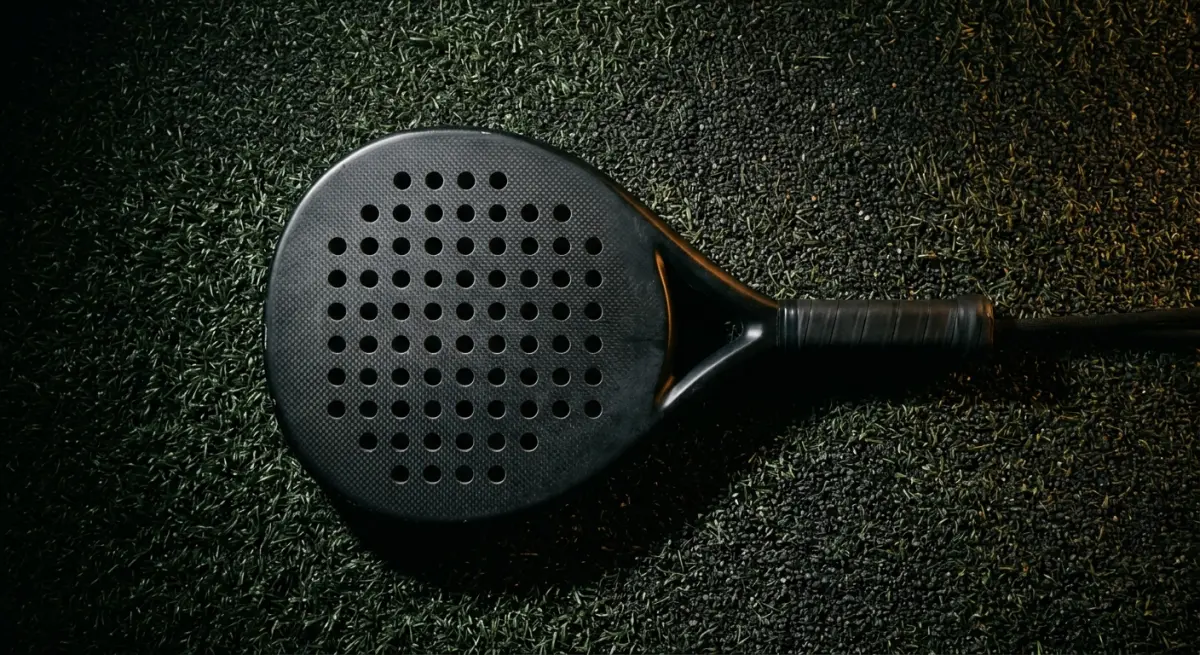
The Babolat Counter Viper 2.6 is the control-minded member of Babolat’s 2026 top-tier range, and one most casual players should think twice about. It is a 365 g carbon racket with a round head, built for players who construct points patiently and attack when the chance comes. This guide explains how it differs from the Technical and Air Viper, and who should walk past it.
Here is the short version: if you are a strong intermediate or advanced player who wins by placement and wants a stable, firm racket, it belongs on your shortlist. If you are newer to the game, or want a light racket that generates pace for you, it does not.
Quick verdict and spec table
The specs below come from Babolat’s own GB product page for the Counter Viper 2.6, checked on 17 October 2026, with UK retailer figures for price. Babolat’s page does not state a skill level, so where we say “advanced” we are quoting retailer copy.
| Spec | Counter Viper 2.6 |
|---|---|
| Shape | Round (Babolat) |
| Weight | 365 g, plus or minus 10 g |
| Balance | Head-heavy (Babolat) |
| Thickness | 38 mm |
| Face | 3K carbon |
| Core | X-EVA |
| Player type | Counter-striker (Babolat) |
| RRP | £280 |
| Street price, 17 October 2026 | £163.90–235.99 (seven UK shops) |
Our verdict: a control racket that UK shops sold at £44–116 below its RRP on 17 October 2026, but one that asks for good technique. Take the street price as a snapshot, because UK sale prices on 2026 stock move quickly.
Babolat gives the balance only as “head heavy”, with no figure in millimetres. Where retailer copy differs from Babolat’s page, we have followed Babolat.
How it plays
The Counter Viper pairs a 3K carbon face with an X-EVA core, which Babolat and retailers describe as a firm, responsive combination. Babolat adds its 3D Spin+ raised surface pattern for grip on the ball, and the Vibrabsorb System² to damp vibration through the carbon, core and handle.
In practice, that means a racket that returns what you give it. A round head puts the sweet spot in the centre of the face, which makes it easier to find than the sweet spot on a diamond-shaped racket. The head-heavy balance adds momentum to volleys and overheads, but it also asks more of your wrist and forearm over a long session.
Control is the main selling point. Babolat pitches it at “strategic players who like to turn defense into a decisive attack”, with extra power coming from the 3K carbon. Expect mishits on a firm carbon racket to be felt.
If you are curious how head shape changes this, our racket shape guide explains round, teardrop and diamond heads, and the racket weight guide covers why 365 g is at the heavier end for casual play.
Counter vs Technical vs Air Viper
Babolat splits its Viper line into three models, each aimed at a different style. All figures below come from Babolat’s GB product pages, checked on 17 October 2026.
| Counter Viper 2.6 | Air Viper 2.6 | Technical Viper 3.0 | |
|---|---|---|---|
| Shape | Round | Teardrop | Diamond |
| Face | 3K carbon | 16K carbon | 3K carbon |
| Core | X-EVA | X-EVA | Hard EVA |
| Weight | 365 g | 355 g | 370 g |
| Balance | Head-heavy | Even | Head-heavy |
| Style | Patient control | Speed and manoeuvrability | Aggressive finishing |
The Air Viper is the one to try if the Counter feels heavy. It is 10 g lighter, Babolat lists its balance as even rather than head-heavy, and retailers describe it as built for extreme manoeuvrability. The Technical Viper is the most attack-minded of the three, and the hardest to use well. Our Technical Viper review covers it in more detail. Our Babolat guide maps the whole range, including the softer Veron and entry-level Vertuo series.
Who should buy it
The Counter Viper makes sense if several of these describe you.
- You have played consistently for a year or more, and your technique holds up under pressure.
- You win points by placing the ball deep and waiting for a short reply.
- You like a firm racket and are comfortable with 365 g in your hand for 90 minutes.
- You want a round shape for a central sweet spot, but still want a carbon face.
If that is you, the street price makes it good value against the £280 RRP. Check your grip size first, since a heavy racket is harder to control on a wrong-sized handle.
Who should look elsewhere
Beginners and early improvers should look somewhere softer and lighter. Our first racket guide explains why £60–100 buys a better learning tool than a £280 carbon racket, and the best value racket page has cheaper picks.
If you are an intermediate looking to step up without spending Viper money, our best padel racket for intermediate players lists softer, cheaper options. If you want something more forgiving across the whole court, the best all-round padel racket guide is the better starting point.
Anyone with elbow or wrist trouble should also be wary of a firm, head-heavy racket. Our guide to rackets for tennis elbow covers softer alternatives.
Where to buy and what to pay
The Counter Viper 2.6 carries a £280 RRP. On 17 October 2026 it was £163.90 at Tennis-Point, £179.99 at Padel HQ, £199.99 at Everything Padel and Express Padel, £214.99 at All Things Padel, £218.99 at PDH Sports and £235.99 at Padel Market UK. Prices on current-season rackets change often, so compare two or three UK stockists before you buy.
Try to demo it first if you can, for example at a retailer or club demo day. A racket this firm and head-heavy is one where five minutes of rallying tells you more than any spec table. For the full kit picture, see our padel equipment guide.