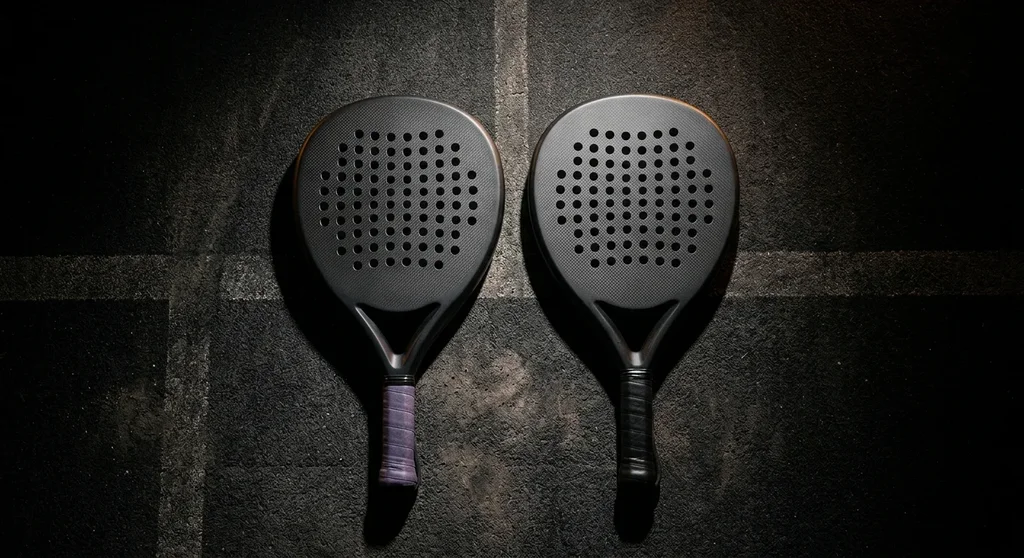
Search “women’s padel racket” and you’ll land on a filtered product page – a “women’s” collection sitting inside a retailer’s normal racket range, distinguished mostly by pink and purple colourways. That collection is most of what the category amounts to.
We found no padel racket built on different engineering principles for women. What retailers call a “women’s racket” is a normal racket – any of the three shapes, an EVA or foam core, the same fibreglass or carbon faces as everything else in the shop – that usually sits at the lighter end of the spec range, wrapped in a colourway aimed at a female buyer. The variables that make it suit a lighter swing or a smaller hand (weight, balance, grip circumference) sit right across the catalogue, filed just as often under “beginner” or “control” as under “women’s.”
That’s good news. The full range is yours to choose from, not a pastel subset of it. Below is what to check when you’re picking a racket, whoever’s buying it.
Is there really a “women’s” padel racket?
We found no distinct build. What’s sold as “women’s” is usually a lighter racket in a colourway aimed at a female buyer, with specs you can also find filed under “beginner” or “control.”
Brands like Bullpadel and Kombat do sell rackets labelled “women’s” at UK shops, and they cover every level. Bullpadel’s women’s range on Padel Market on 18 October 2026 ran from the round, beginner-level Indiga W to the Vertex W 05, a 350–360g diamond for advanced players. The listings describe the same kinds of materials as the unisex range – the Indiga W and the unisex Indiga Power both use a soft EVA core, for example – with weight and shape varying model by model.
Where this diverges from padel shoes is worth naming, because we’ve covered that ground before. Our padel shoes for women guide explains real differences in foot shape and volume that justify separate lasts and sizing. Feet vary structurally by sex on average. A solid-faced racket, gripped and swung by an arm, doesn’t have an equivalent structural variable. There’s nothing for a “women’s” engineering category to attach to.
What matters: grip size
Pick a grip size by measuring your hand, whoever the racket is marketed at.
Grip size correlates with hand size, and hand size correlates loosely with gender – which is exactly why “women’s” ranges lean on it. The correlation is loose enough that using gender as a proxy will steer plenty of buyers wrong. Measure your hand instead of trusting the label: our grip size guide covers how.
Buy on the measurement. A player with larger hands gains nothing from a “women’s” racket that ships with a small grip – they’ll be fighting the handle all match. An overgrip adds a little thickness if a specific model you want feels slightly thin in the hand.
This matters more than it sounds. A grip that’s too small tends to make you squeeze harder, and the NHS says tennis elbow can come from activities that involve gripping something and repeatedly twisting your wrist and forearm. It costs nothing to check before you buy.
What matters: weight
What weight suits a beginner starting padel? The same range of around 350–370g that suits any new player, regardless of who’s buying it.
This is where “women’s” rackets do differ from the unisex flagship models – they tend to sit lighter. Bullpadel’s women’s Vertex W 05 and Wonder are listed at 350–360g on Padel Market, where Everything Padel lists the unisex Vertex 05 Comfort at 360–370g. That’s a real, useful difference for anyone with a lighter or faster swing. It has nothing to do with sex as such. A 60kg beginner of any gender benefits from the same lighter frame; a powerful player who happens to be a woman might prefer the heavier end entirely.
Balance is worth checking separately, since a women’s diamond can still be head-heavy. A head-light balance – weight shifted towards the handle – makes a racket easier to manoeuvre at the net and less tiring over a long session. Again, that is useful for a slower or newer swing, whoever is holding it.
What matters: shape and level
Shape decides where the sweet spot sits on the face, and it matters more than any weight figure. Round shapes centre the sweet spot and forgive off-centre contact – the right call for anyone still building consistent technique. Teardrop pushes the sweet spot slightly higher for more pop once your swing has settled. Diamond puts it highest of all, rewarding clean contact and punishing mishits – a shape for committed, technically confident players.
None of this shifts by gender. A beginner buying their first racket should pick round regardless of who they are; an experienced player reaching for more power should look at diamond regardless of who they are. Our racket shapes guide breaks down how each shape affects spin, control, and power in more depth.
Level matters more than any other variable here, which is exactly why retailer “women’s” pages get it wrong so often – they filter by gender when they should be filtering by how long you’ve been playing. A first-season player and a three-year veteran who happen to share a gender have almost nothing in common in terms of what racket suits them. A first-season player and someone of a different gender who started around the same time usually have a great deal in common.
Best picks by category
Skip the women’s aisle and shop the full range by level instead – the picks that suit you will be listed by shape, weight, and price tier, not by who the marketing department imagined buying them.
- New to padel: a round-shaped racket around 350–370g, typically £60–100. Full model recommendations are in our best padel racket UK guide, and if you’re still working out shape and core material from scratch, start with our first racket decision framework.
- Settled technique, want more pop: teardrop shape, 360-375g, £100-160.
- Confident, attacking player: diamond shape, 365-380g, £160-250 – or a lighter diamond model around 350-365g if you want that shape’s sweet spot without the extra mass.
If a specific “women’s” model catches your eye because of the colourway or the price, that’s a fine reason to buy it – just check the weight, shape, and grip circumference against what you need, the same way you would for any other racket on the shelf.