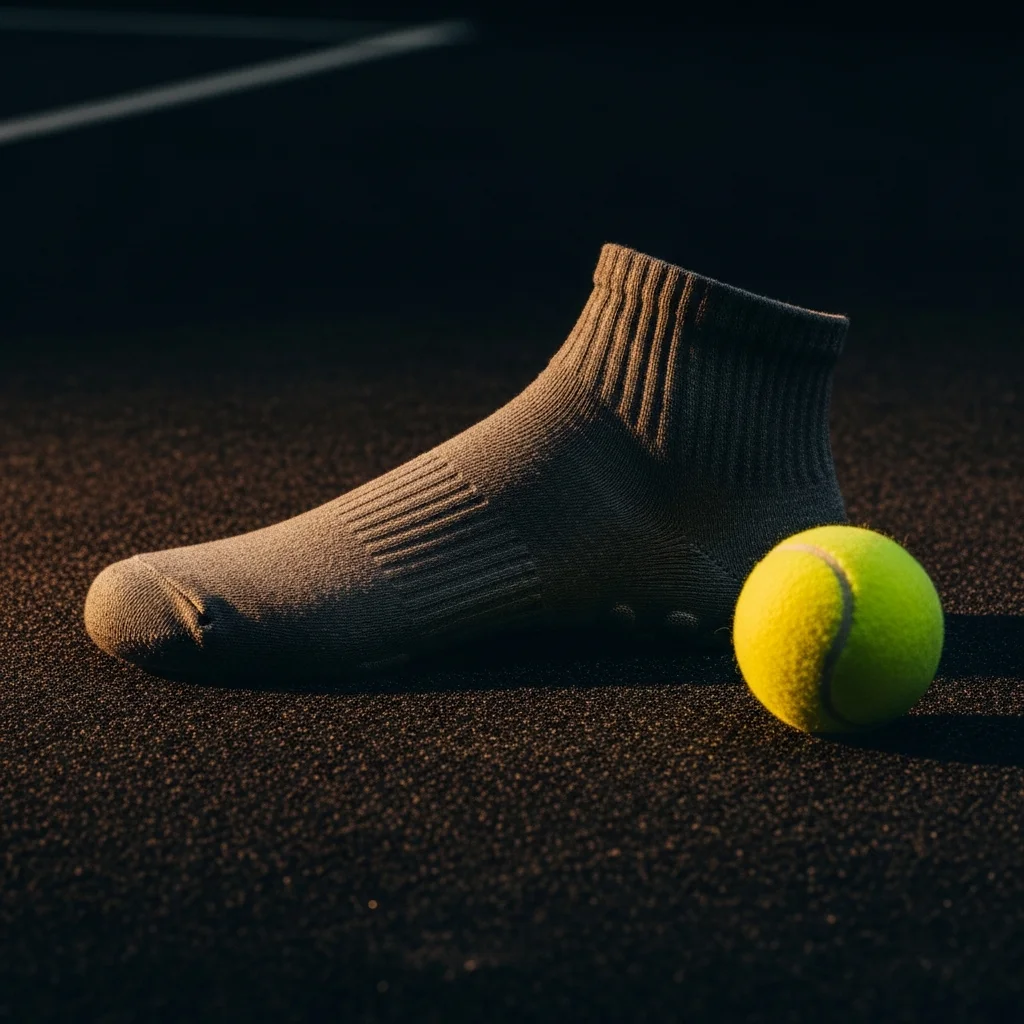
You’ve sorted the shoes. Herringbone outsole, decent lateral support, the right sole for artificial turf. Then you play a two-hour session in the same cotton socks you wear to the gym and spend the next morning wincing every time you put weight on your left heel.
Socks are the accessory nobody researches before buying, which is odd, because padel is unusually hard on feet. The court is smaller than a tennis court, enclosed by glass and mesh, and most points involve short, sharp changes of direction rather than the longer, more linear running you get on a bigger surface. Every stop, cut, and recovery step loads the same few pressure points on your heel and forefoot, over and over, for the length of a match. That’s a friction problem before it’s anything else, and the right sock solves it for less than the cost of a tube of balls.
Why padel is hard on your feet
Padel’s enclosed court packs lateral movement into a small space, causing repeated stop-start friction on the same spots inside your shoe.
Tennis gives you room to run through a shot. Padel doesn’t – the glass and mesh mean you’re constantly shuffling sideways, stopping dead, and reversing direction to chase a ball back off the wall. That repeated shuffle-stop pattern grinds your foot against the inside of the shoe in the same handful of places: the back of the heel, the ball of the foot, the inside edge where you plant to change direction. A single sweaty, low-cushion sock doing that job for ninety minutes is how blisters start.
It’s not really about the socks looking the part. It’s about reducing the friction that builds up over a session, which is a fitness problem as much as a comfort one – nobody plays their best padel while favouring a blister in the third set.
Where the cushioning matters most
Look for padding concentrated at the heel and forefoot, plus arch support that keeps the sock snug rather than bunching inside the shoe.
Not every part of a sports sock needs the same thickness. The two zones worth checking before you buy are the heel, which takes the impact on every stop, and the forefoot, which absorbs the push-off on every direction change. A sock with even, all-over padding often just adds bulk without protecting the parts that need it.
Arch support matters more than most players expect. A sock that grips the arch stays in place through a session; one that doesn’t will slowly bunch and fold inside the shoe, creating exactly the kind of friction point you were trying to avoid. This is the gap between “any sports sock” and a sock built for court movement – the difference isn’t dramatic to look at, but it’s the difference between finishing a match comfortable and finishing it limping.
Material: why cotton is the wrong choice
Moisture-wicking synthetic blends pull sweat away from the skin; cotton holds it against your foot, which is what causes most blisters.
This is the single most useful piece of practical advice in this guide. Cotton feels soft and familiar, which is exactly why so many players default to it – but cotton absorbs sweat and holds onto it, and a damp sock against skin is a much higher blister risk than a dry one. The friction itself doesn’t change much between materials; what changes is how much moisture is sitting between your foot and the fabric while that friction happens.
Look for polyester, nylon, or blends specifically marketed as moisture-wicking – most running and court sock ranges use these as standard now, so you’re not hunting for anything exotic. A merino wool blend works too, if you don’t mind paying slightly more, and has the bonus of resisting odour over a long session.
Sock height: ankle, quarter, or crew
Crew length socks (mid-calf) work well for both indoor and outdoor padel; ankle socks are a fine lighter option for indoor courts specifically.
Height comes down to personal preference more than performance, with one exception. Outdoor courts expose more of your lower leg to debris, sun, and occasionally rougher surrounds around the court edge, so a crew-length sock gives a bit more coverage and protection than an ankle sock. Indoors, where conditions are more controlled, ankle socks are perfectly fine if you prefer the lighter, cooler feel.
Quarter-length socks – sitting just above the ankle bone – are a reasonable middle ground if you can’t decide. There’s no meaningful performance gap between the three heights; this is a comfort and personal-style call, not an equipment upgrade in the way cushioning and material are.
How socks work alongside your shoes
Good socks complement your padel shoes’ grip and cushioning, finishing a job the shoe itself starts.
It’s worth being clear about what a good sock can and can’t fix. If your shoes lack lateral support, cushioning, or the right outsole for artificial turf, no sock is going to compensate for that. Our padel shoes for men and padel shoes for women guides cover what to look for in the shoe itself – get that right first. Socks are the layer that makes a good shoe fit properly and stay comfortable, reducing the small movements inside the shoe that cause blisters over a long session.
Budget: this doesn’t need to be expensive
Decent cushioned sports socks cost roughly £5-15 for a multipack, making this one of the cheapest upgrades in your padel kit bag.
Unlike rackets or shoes, socks aren’t a category where spending more buys you a meaningfully better experience past a certain point. A multipack of cushioned, moisture-wicking sports socks from a mainstream running or court brand will do everything described in this guide for well under £15. Padel-specific sock lines exist and are perfectly good, but you’re mostly paying for branding rather than a material step up in performance. If you already own decent cushioned running socks, they’ll do the job – there’s no need to buy a padel-labelled version specifically.
The only real spending decision is whether to go synthetic or merino wool. Synthetic blends are cheaper and dry faster; merino costs a bit more but resists odour better over back-to-back sessions. Either solves the actual problem, which is moisture and friction, not brand or price point.