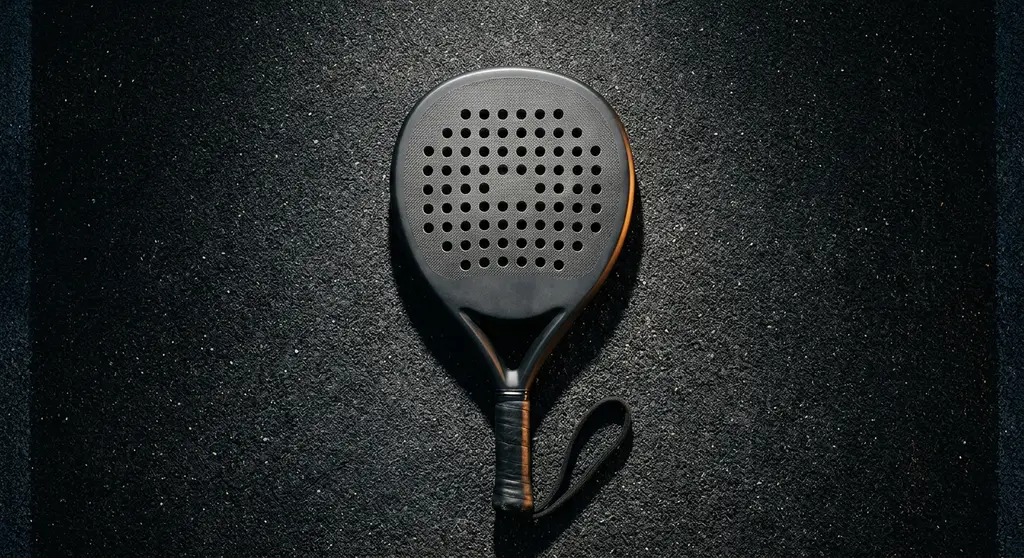
Search for a “spin racket” and most gear-store listicles will point you at whatever’s diamond-shaped and expensive. That misses the part that matters most. Spin comes mostly from a textured face gripping the ball at contact, combined with the swing path you bring to the shot. Shape plays a smaller supporting role. If you’ve started working on your bandeja, vibora, or a spin serve and want a racket that helps, here’s what to look for and which models deliver it.
What generates spin
A textured or “rough” face surface increases friction between the strings-free padel face and the ball at the moment of contact. More friction means more grip, and more grip means the ball leaves the face rotating rather than just travelling. Manufacturers achieve this with sandpaper-style coatings, raised 3D patterns, or directional grooves pressed into the carbon or fibreglass surface.
Texture alone won’t put spin on the ball. You still need a swing path that brushes across or up the back of the ball rather than driving straight through it – the same brushing motion that makes a vibora skid low and kick sideways off the side wall after the bounce, where a flat smash would sit up. A rough face amplifies a swing that’s already generating spin. It does very little for a flat swing.
Our Nox ML10 Pro Cup guide shows the idea in one family: every version has a fibreglass face, and the Rough Surface version adds a textured face for extra grip on the ball. The principle is the same across every racket on this list – only the surface pattern and shape change.
Manufacturers describe their texture in different ways – 3D roughness, sandpaper finish, directional grooves, arrowhead patterns – but they’re all solving the same problem. More surface contact at the point where the ball meets the face means more rotation transferred into the shot. None of it replaces the swing. A rough face on a flat, driving swing still produces a flat, driving shot. It just won’t grip the ball the way a smoother face would if you did generate the brushing action.
Texture also fades. Every rough face smooths down gradually with use, faster on abrasive outdoor courts than on indoor ones, and faster still if you’re playing several times a week. Most players notice a drop-off in bite after a season or two of regular play – ordinary wear, not a manufacturing flaw. It’s worth knowing before you buy, so you’re not surprised when a two-year-old racket doesn’t grip the ball the way it did when new.
How much shape matters for spin
Diamond-shaped rackets put more weight in the head, which adds raw power to overheads and makes the ball easier to drive hard once you’ve generated spin. Round rackets centre the sweet spot and forgive off-centre contact but do less to help you overpower a shot. Our racket shape guide covers this trade-off in full if you’re still deciding between round, teardrop, and diamond.
For spin specifically, hybrid and teardrop shapes are worth taking seriously. They keep some of the forgiveness of a round face while still shifting the sweet spot up enough to help on overheads. Wilson’s Bela V3, for example, pairs a teardrop head with a textured face, because the texture is doing more of the spin work than the shape is.
That’s a useful distinction to hold onto when you’re comparing rackets on a shop page. A diamond shape and a textured face solve different problems – one adds power once you’ve hit the ball, the other adds grip at the moment you hit it. Buying a diamond racket expecting it to add spin on its own is a common and expensive mistake. Check the face description for words like “rough,” “textured,” or a named spin technology before assuming shape alone will do the job.
The recommendations
None of these are beginner rackets. All assume you already have a swing that produces some spin and want the racket to support it.
| Racket | Shape | UK price (18 Oct 2026) | Best for |
|---|---|---|---|
| Babolat Technical Viper 3.0 | Diamond | £191.99–271.99 (RRP £320) | Players who want maximum power alongside spin |
| Bullpadel Vertex 05 Comfort 2027 | Diamond | £214.99–216 (RRP £240) | Attacking players who want a softer feel with spin |
| Wilson Bela V3 range (V3, Pro V3, LS V3) | Teardrop / Sledge | £127.90–205.99 | Fans of Fernando Belasteguín’s signature spec |
| Head Extreme line (One/Pro/Motion) | Diamond | £161.90–230 | The most accessible entry point on this list |
Babolat Technical Viper 3.0 – £191.99–271.99 (RRP £320). Babolat lists 3K carbon faces, a Hard EVA core with a Carbon Power Layer inside the rubber for energy transfer, and a rough finish that it says helps generate spin. The diamond shape, head-heavy balance and 370g (±10g) weight put real power behind the ball once spin is applied. This is a racket for players with settled technique, not a first upgrade. On 18 October 2026 it was £191.99 at PDH Sports and Express Padel, around £195–209 at Racketworld, Everything Padel, Padel HQ and Tennis-Point, and £271.99 at Padel Market.
Bullpadel Vertex 05 Comfort 2027 – £214.99–216 (RRP £240). Express Padel lists a Top Spin rough surface, a Fibrix face that mixes carbon fibre and fibreglass, and a Multieva core, aimed at players who want Vertex power with a softer feel. It’s a diamond, and Everything Padel gives the weight as 360–370g, so it’s built for players who already generate racket-head speed. On 18 October 2026 it was £214.99 at PDH Sports, Everything Padel, Express Padel and Racketworld and £216 at Padel HQ.
Wilson Bela V3 range – £127.90–205.99. This is Belasteguín’s signature series. Wilson gives the Bela V3 (teardrop, 363g) and Bela Pro V3 (370g) its Spin2 face texture, and the lighter Bela LS V3 (355g) a dual-density texture. Wilson calls the Pro and LS head shape “Sledge”, which Padel Market and Tennis-Point describe as a teardrop. On 18 October 2026 the Bela V3 was £161–174.99 (PDH Sports, Tennis-Point, Padel Market), the Pro V3 £184.90–205.99 and the LS V3 £127.90–161.99 (Tennis-Point, Racketworld, Padel Market).
Head Extreme line (One, Pro, Motion) – £161.90–230. All three are diamonds with Head’s Extreme Spin rough face texture. Everything Padel lists the Pro at 370g and head-heavy, and the Motion at 360g, lighter and more manoeuvrable than the Pro. On 18 October 2026 the Motion 2026 ran from £161.90 (Tennis-Point) to £200 (Padel HQ), the Pro 2026 from £189.90 to £230 and the One 2025 from £169.99 to £220.99. If you want to try a textured face without committing to premium pricing, this is the sensible place to start.
Who this is for
A textured face is a marginal gain on top of technique you already have. If you’re still building your vibora or working out when to reach for it over a bandeja, spend the next few months on the shot itself before spending £250 on the racket that supports it. Once the swing is there – roughly year two onward for most players who practise regularly – a rough or textured face will sharpen shots you can already produce, and the difference is noticeable on viboras and spin serves in particular.
If you’re not sure which racket suits your level more broadly, our UK buying guide covers picks across every price bracket and playing stage, not just spin.